- Jun 26
More Traffic Won’t Fix Your Ecommerce Problem
- Adam Renico
It’s a familiar moment.
Ecommerce is underperforming. Revenue is not where it should be. The website is live, campaigns are running, Amazon or marketplace channels may be active, but the results still feel lower than expected.
And almost immediately, the conversation turns to demand.
Do we need more traffic? More ad spend? More campaigns? More awareness? More people seeing the product?
It feels like the most logical place to start. If more people see the product, more people should buy.
In practice, that is rarely where the real ecommerce problem sits.
More traffic is often treated like a growth strategy when it is actually an amplifier. It makes whatever is already happening inside the business more visible. If the ecommerce function is aligned, traffic can accelerate growth. If ownership is unclear, conversion is weak, pricing is inconsistent, or channel roles are not defined, traffic usually exposes those gaps faster.
That is why more ecommerce traffic does not automatically create better ecommerce performance.
It can help.
But only when the business is ready to turn that attention into profitable revenue.
Why Traffic Becomes the Default Answer
Traffic becomes the default answer because it is visible. It is measurable. It gives teams something to act on quickly.
Marketing can launch campaigns. Budgets can be adjusted. Paid media can be scaled. Reports can be reviewed. Performance can be discussed weekly. Compared with clarifying ecommerce ownership, pricing logic, channel roles, customer experience, and internal accountability, traffic feels much easier to move.
That is part of the problem.
In many companies, ecommerce underperformance gets framed as a marketing issue because marketing owns the most visible levers. If revenue is low, the assumption becomes that not enough people are seeing the offer. More visitors should mean more sales, so the business adds more activity at the top of the funnel.
But that assumption skips over a harder question:
Who owns turning that attention into revenue?
That is where many ecommerce conversations start to break down.
Traffic can be bought. Campaigns can be launched. Awareness can be created. But if the business does not have clear ownership across conversion, pricing, margin, customer experience, channel strategy, and fulfillment realities, more traffic may not fix the issue.
It may make the issue more expensive.
Traffic Is an Amplifier, Not a Strategy
Traffic matters. No ecommerce channel grows without demand. A website needs visitors. Amazon listings need visibility. Marketplace products need exposure. Customers need to find the offer before they can buy.
But traffic by itself is not the strategy.
Traffic is the test of whether the strategy holds.
When more visitors arrive, the business quickly learns whether the offer is clear, the pricing makes sense, the product content supports the sale, the buying path is easy enough, and the channel experience matches customer expectations.
If those pieces are working, traffic becomes more valuable. More qualified visitors can lead to more orders, stronger conversion, better customer acquisition, and healthier revenue growth.
But if those pieces are weak, traffic tends to expose the weakness.
More traffic does not fix unclear positioning. It does not fix pricing conflicts. It does not fix weak product content. It does not fix a confusing buying experience. It does not fix a poor Amazon listing. It does not fix a marketplace strategy that is creating margin pressure. It does not fix a business model where ecommerce revenue is spread across multiple teams, but no one fully owns the outcome.
Traffic simply sends more people into the system that already exists.
That is why the same campaign can produce very different results in two different companies. One business has clear channel roles, strong pricing discipline, clean product content, a good buying experience, and clear ecommerce accountability. Another business has fragmented ownership, channel conflict, inconsistent pricing, weak conversion, and unclear margin expectations.
Both can increase traffic.
Only one is ready to turn that traffic into profitable growth.
What Actually Happens When You Add More Traffic
When more traffic hits an ecommerce channel that is not clearly owned, it rarely solves the problem. It exposes it.
Conversion issues become more obvious. Pricing inconsistencies across channels become harder to ignore. Marketplace listings get more attention, but not necessarily more profitable orders. The website gets more visitors, but the buying experience still creates friction. Revenue may increase slightly, but margin can compress at the same time.
From the outside, this can look like progress.
Internally, it often creates more strain.
The business is paying to send more people into a channel that no one fully owns.
This is where ecommerce growth can become misleading. A campaign may drive more sessions. Amazon spend may increase visibility. A marketplace promotion may create a temporary lift. A paid search campaign may generate more orders. But if the underlying economics are weak, the business may be buying activity rather than building a stronger ecommerce channel.
That can create a frustrating cycle.
The business spends more to drive traffic. Revenue improves a little, but profitability does not. Leadership asks why ecommerce is still underperforming. Marketing points to conversion, pricing, or product content. Sales points to channel conflict. Operations points to fulfillment pressure. Finance points to margin. Customer service points to friction after the order.
Each team may be right from its own point of view.
But the broader issue remains: the company is trying to scale attention before it has clarified who owns the ecommerce outcome.
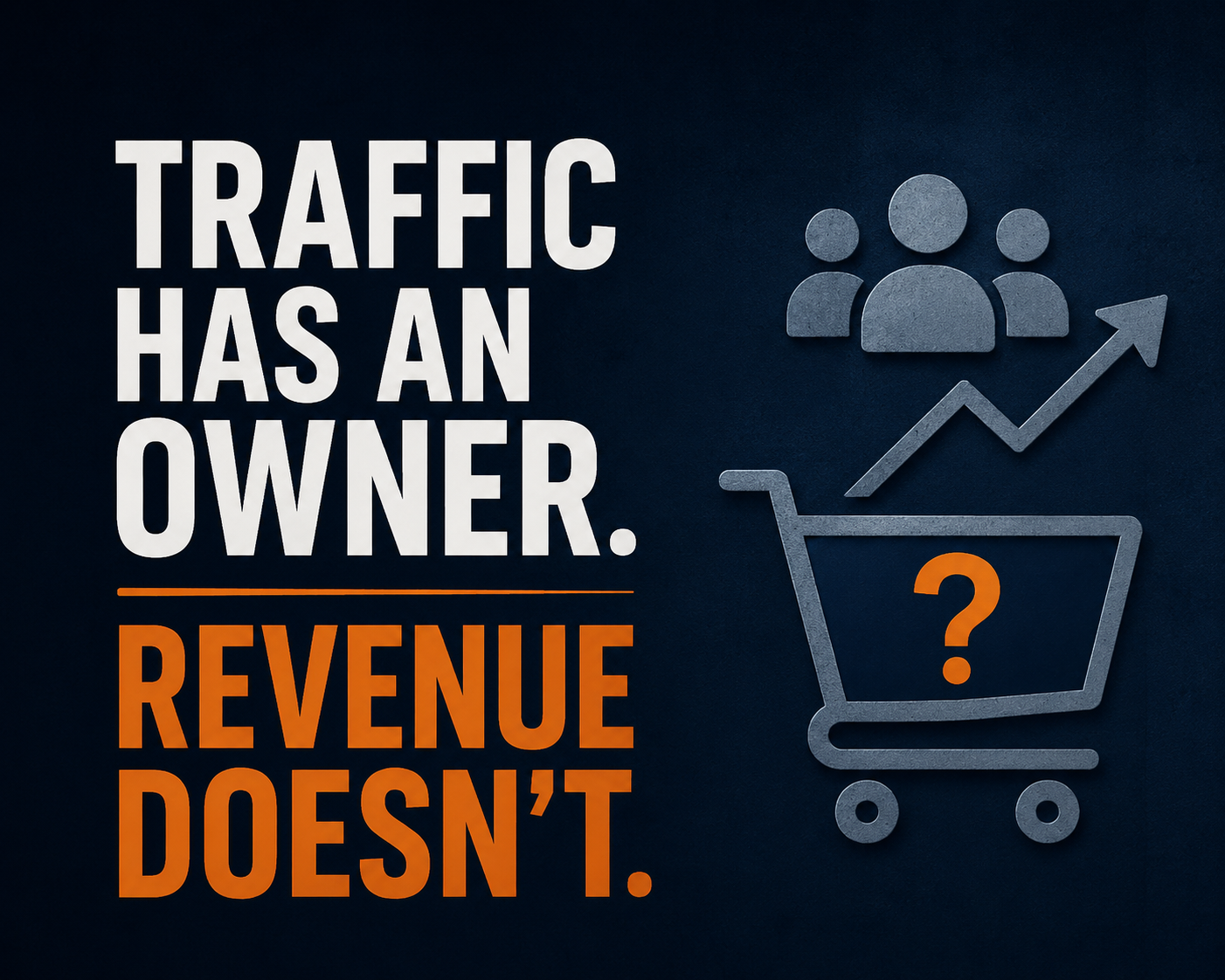
The Overlooked Issue: Traffic Has an Owner, Revenue Often Does Not
This is the part many teams miss.
Traffic usually has a clear owner. An internal marketing lead, an agency, a platform partner, or a media budget. There is usually a dashboard, a plan, and a reporting cadence. Someone is watching impressions, clicks, sessions, cost per click, conversion rate, return on ad spend, and campaign performance.
Revenue ownership is often much less clear.
Sales cares about channel relationships. Marketing cares about demand and brand. Operations cares about fulfillment and service levels. Finance cares about margin. Customer service sees the friction after the sale. Ecommerce may sit somewhere between those teams, trying to connect the pieces.
Each team owns part of the experience.
But no one may fully own the ecommerce result.
That creates a strange situation. The company can increase traffic quickly, but it cannot always answer who is responsible for making that traffic profitable.
Who owns conversion once the visitor arrives? Who owns margin when promotions increase order volume but weaken profitability? Who decides whether Amazon growth is helping or hurting the broader channel strategy? Who resolves pricing conflicts across DTC, marketplaces, wholesale, and retail? Who is accountable when the website gets traffic, but customers hesitate to buy?
Those questions matter because ecommerce revenue is rarely created by traffic alone.
It is created by the connection between demand, offer, pricing, channel strategy, customer experience, fulfillment, and accountability.
If those pieces are not connected, more traffic can create more motion without producing better performance.
Why More Activity Can Make the Problem Worse
More activity feels productive, but it can create noise when ecommerce ownership is unclear.
A campaign launches before pricing is aligned. A marketplace promotion runs without a clear view of its impact on other channels. Amazon gets more spend while listings remain weak. Website traffic increases while the buying path still creates hesitation. A new agency pushes campaigns before the business has defined the role each channel should play.
Each action may be defensible on its own.
But the total system does not improve.
This is where ecommerce teams can become busy without becoming more effective. More meetings happen. More reports get reviewed. More campaigns go live. More budget gets discussed. More pressure gets placed on the visible marketing levers.
But if the constraint is ownership, pricing, conversion, channel conflict, or customer experience, more traffic does not remove the constraint.
It feeds it.
That is why increasing traffic too early can make ecommerce feel more chaotic. The business generates more data, more questions, more internal pressure, and more cross-functional tension, but the root issue remains unresolved.
The company is doing more.
It is not necessarily fixing the problem that is holding ecommerce back.
Questions to Ask Before Increasing Ecommerce Traffic
Before asking how to drive more ecommerce traffic, leadership should ask a few harder questions.
Who owns ecommerce revenue across channels?
Who is accountable for margin, not just sales?
Who decides how Amazon, DTC, marketplaces, wholesale, distributors, and retail should work together?
Who owns conversion after the visitor arrives?
Who has the authority to resolve conflicts between growth, pricing, customer experience, and operations?
Who is responsible for making sure paid traffic turns into profitable revenue?
These questions are less comfortable than reviewing traffic numbers, but they usually reveal more.
They help leadership see whether ecommerce is being managed as a coordinated revenue function or as a collection of disconnected activities.
That distinction matters because traffic is not the strategy.
Traffic is the test of whether the strategy holds.
If the business cannot answer who owns the outcome, more traffic may only create a louder version of the same problem.
What Actually Changes Ecommerce Performance
Ecommerce starts to perform differently when ownership is clear.
Someone has to own the outcome beyond campaigns and traffic. That means looking at how the channel converts, how pricing supports or weakens the strategy, how listings are positioned, how promotions affect margin, and how the customer experience works across touchpoints.
It also means connecting ecommerce to the broader business, not treating it as a marketing campaign or a side channel.
For manufacturers, distributors, and product brands, this can be especially challenging because ecommerce often sits across several existing teams. Sales may own customer relationships. Marketing may own demand generation. Operations may own fulfillment. Finance may own margin review. Product may own catalog data. Customer service may own post-purchase issues.
But customers do not experience those departments separately.
They experience the buying process as one connected path.
That is why ecommerce performance improves when someone is responsible for connecting the pieces. The goal is not to remove sales, marketing, operations, finance, or customer service from the process. The goal is to make sure the work adds up to a clear commercial outcome.
With that kind of ownership in place, traffic becomes more valuable.
Without it, traffic often becomes a more expensive way to learn that the business was not aligned.
Closing
More traffic can help.
But it only works as a multiplier.
If ownership is unclear, traffic multiplies friction. If ownership is clear, traffic can multiply performance.
That difference is often the line between ecommerce that is active and ecommerce that produces.
If This Sounds Familiar
Many companies have already invested in campaigns, tools, agencies, and traffic. The harder challenge is turning that attention into consistent, profitable revenue across channels.
If your ecommerce channels are getting traffic but not producing the revenue, margin, or customer behavior you expected, the issue may not be demand. It may be what happens after the traffic arrives.
That is where an Ecommerce Assessment can help clarify what is holding performance back across ownership, pricing, channel strategy, conversion, margin, and customer experience.
If you are seeing that gap, I’m always open to comparing notes.