- Jun 26
Who Should Own Ecommerce Revenue?
- Adam Renico
One of the most revealing questions you can ask a leadership team is also one of the simplest:
Who owns ecommerce revenue?
At first, the answer usually sounds obvious. There may be someone managing the website, someone running paid campaigns, another person involved with Amazon or marketplaces, and someone close to pricing, operations, or customer service.
From the outside, it can look like ecommerce already has ownership because the work has owners.
But once the question becomes more specific, the room often changes.
Who owns ecommerce performance across channels? Who has the authority to make decisions when pricing conflicts with marketplace growth? Who is responsible for conversion, margin, customer experience, and channel alignment as one connected outcome?
That is where the answers usually become less direct.
People begin referencing different teams, different functions, and different responsibilities. And that makes sense. Ecommerce touches sales, marketing, operations, finance, customer service, technology, and outside partners.
Everyone is involved.
But involvement is not the same thing as ownership.
That distinction matters because most companies do not have an ecommerce activity problem. The work is happening. Meetings are happening. Reports are being reviewed. Campaigns are being launched. Agencies may be involved. Technology investments have already been made.
The issue is that all of this activity does not always add up to clear accountability.
When revenue stalls, margin compresses, channels start working against each other, or digital growth creates friction with sales, there is often no single owner responsible for solving the issue across the business.
And when ownership is unclear, ecommerce becomes reactive instead of intentional.
What Most Companies Think Ecommerce Ownership Means
Part of the confusion comes from the fact that many companies already have people working in ecommerce.
Someone manages the website. Someone runs paid campaigns. Someone handles Amazon listings or marketplace operations. Agencies may be involved. A sales leader may weigh in on pricing. Operations may support fulfillment. Finance may review margin. Customer service may deal with issues when something breaks.
From the outside, that can look like ownership.
But task ownership and revenue ownership are not the same thing.
Managing a channel is not the same as owning the business outcome of that channel. A person can own website updates without owning ecommerce growth. An agency can own paid media without owning profitability. A marketplace manager can own listings without owning the broader channel strategy. A marketing team can drive traffic without owning conversion, customer experience, margin, or sales alignment.
That is where many companies get stuck.
Ecommerce gets divided into functional pieces. The website has a person. Amazon has a person. Paid media has a person. Email has a person. Product content has a person. Reporting has a person.
But the larger question remains unanswered:
Who owns the outcome?
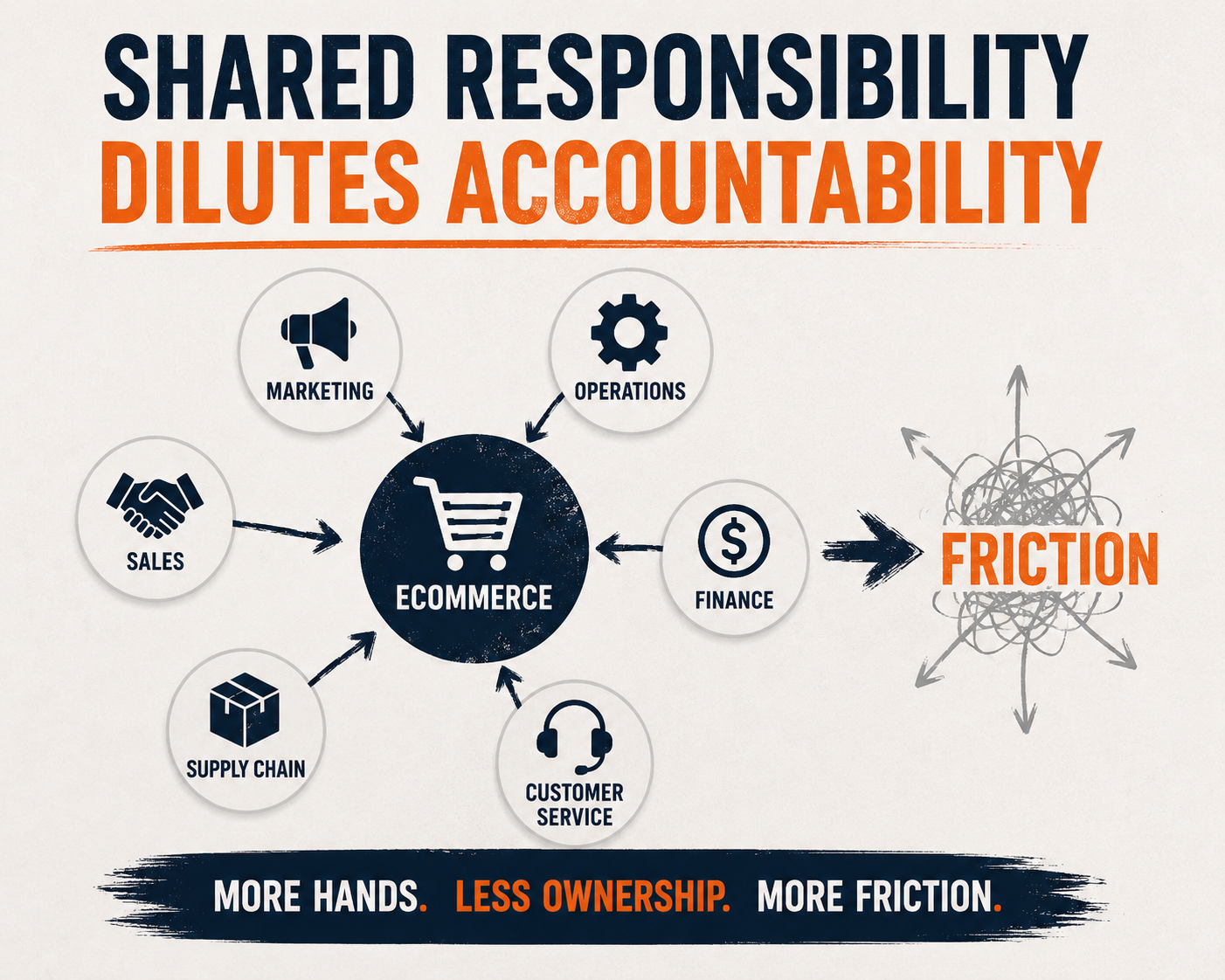
This becomes more of an issue as ecommerce grows across the business. Sales influences pricing and channel relationships. Marketing drives demand. Operations manages fulfillment realities and inventory constraints. Finance watches profitability. Customer service hears where the customer experience is breaking down.
Each team sees part of the picture.
Very few people are responsible for the full picture.
That is usually where ecommerce begins drifting into ambiguity. Activity continues, but difficult decisions slow down between departments. Pricing conflicts linger longer than they should. Marketplace strategy becomes reactive. Customer experience issues remain unresolved because fixing them requires coordination across teams with different priorities.
Over time, ecommerce can start functioning more like a shared responsibility than a business function with clear accountability.
Revenue may still grow for a while. But eventually the gaps become harder to ignore. Teams begin protecting their own priorities. Performance conversations become harder to untangle because multiple departments contribute to the outcome, but no one fully owns improving it.
That is usually when leadership starts feeling the friction.
Why Unclear Ownership Survives for So Long
One reason ecommerce ownership problems are difficult to recognize early is that many businesses can grow for a while without solving them.
A website launches and starts generating orders. Amazon gains traction. Marketplace channels create incremental revenue. Traffic increases. Campaigns run. Reports show progress.
From the outside, ecommerce appears to be working.
And for a while, it is.
That early momentum can make the structure underneath the business feel stronger than it actually is. As long as revenue is growing, leadership teams often tolerate unclear ownership because the friction has not fully surfaced yet.
The problem is that ecommerce complexity compounds quietly over time.
More channels get added. Pricing pressure increases. Advertising costs rise. Marketplace competition becomes more aggressive. Customer expectations increase. What once felt manageable through informal coordination becomes harder to hold together.
That is when the tension starts becoming visible.
Marketing feels pressure to drive more traffic while conversion issues remain unresolved. Sales becomes more sensitive to channel conflict and pricing consistency. Operations struggles with fulfillment expectations created by promotions or marketplace requirements. Finance starts watching margin compression more closely.
None of those issues exist independently.
They are connected through ecommerce performance, but there is often no single owner responsible for resolving them across the business.
That is why the problem can feel confusing. On paper, each issue may have a logical explanation. The website needs work. The Amazon catalog needs attention. Pricing needs review. The agency needs clearer direction. The customer portal needs more adoption. Reporting needs improvement.
Those may all be true.
But if the same types of issues keep resurfacing, the deeper issue may not be the platform, the agency, or the tactic. It may be the operating model around ecommerce.
The business has activity.
It may not have ownership.
What Changes When Ecommerce Ownership Becomes Clear
When ecommerce ownership becomes clear, the first thing that usually changes is not traffic or even revenue.
It is decision-making.
Conversations become faster. Priorities become clearer. Teams spend less time working around internal ambiguity because someone is responsible for balancing channel growth, pricing, customer experience, operational realities, and profitability together.
That changes the tone of ecommerce discussions.
Instead of each department managing its portion of the business in parallel, someone becomes responsible for how the pieces work together. Marketplace decisions get evaluated within the context of broader channel strategy. Pricing conversations become less reactive. Customer experience issues get resolved with a clearer view of how decisions in one area affect the rest of the business.
That does not mean disagreement disappears. Ecommerce still creates tension because it sits at the intersection of multiple departments with different priorities.
Sales may care most about customer relationships. Marketing may care most about demand generation. Finance may care most about margin. Operations may care most about execution realities. Customer service may care most about reducing friction.
Those tensions are normal.
The issue is not whether they exist. The issue is how the business resolves them.
Without ownership, conflicts linger. Decisions get delayed. Teams continue optimizing for their own goals because no one has the authority to make tradeoffs across the ecommerce operation as a whole.
With ownership, the business gains a clearer mechanism for resolving those conflicts intentionally instead of reacting to each issue as it appears.
At a certain point, ownership stops being a nice organizational improvement.
It becomes an operating requirement.
The Pattern Leadership Teams Eventually Feel
Most ecommerce ownership problems do not announce themselves clearly.
They rarely appear as one obvious failure. More often, they show up as a growing collection of smaller frustrations that become harder to untangle over time.
Pricing discussions take longer than they should. Marketplace decisions become more reactive. Promotions create unintended consequences across other parts of the business. Customer experience issues remain unresolved because solving them requires coordination across multiple departments with different priorities.
Individually, each issue can seem manageable.
Collectively, they create a constant sense of friction around ecommerce.
That is usually when leadership teams start realizing the problem is larger than a campaign, platform, or channel tactic.
The business is not struggling because people are not working hard enough. In many cases, the opposite is true. Teams are working constantly, but increased activity does not create alignment by itself.
Without clear ownership, the organization becomes more reactive as complexity grows. Decisions start depending on consensus rather than accountability. Teams protect their own priorities because no single leader is responsible for balancing the full ecommerce outcome across the business.
Over time, that operating pattern becomes expensive.
It shows up financially through slower growth, weaker margin, higher acquisition costs, and missed opportunities. It also shows up organizationally. Ecommerce starts consuming more leadership attention and operational energy than the results seem to justify.
That is usually the point where leadership teams realize they do not simply have an ecommerce execution issue.
They have an ecommerce ownership issue.
Ecommerce Ownership Is More Than a Role
Ecommerce ownership is often discussed as a role, a department, or a reporting structure.
In practice, it is more operational than that.
It is clear accountability for how ecommerce performs across channels, pricing decisions, customer experience, profitability, and the growing complexity that comes with scale.
That does not mean one person does every task. Ecommerce will always require support from sales, marketing, operations, finance, customer service, technology, and outside partners.
But someone needs to own how those pieces come together.
That owner needs enough authority to connect the dots across the business. They need to understand the commercial strategy, channel roles, pricing realities, customer experience, operational constraints, and performance metrics. They also need the support of leadership when hard tradeoffs need to be made.
Without that, ecommerce leaders often become coordinators instead of owners. They manage agencies, gather updates, review reports, and chase decisions, but they do not have the authority to fix the larger issues slowing the business down.
That creates frustration for everyone.
The ecommerce team feels stuck. Sales feels exposed. Marketing feels pressure to produce results. Finance sees margin concerns. Operations feels the strain of decisions made elsewhere. Leadership sees activity, but not enough progress.
Clear ownership does not remove every challenge, but it gives the business a better way to address them.
Closing
Many companies already have good people, active channels, and strong products in place. The challenge is usually not effort.
The challenge is creating clear ownership across an ecommerce operation that has become more connected, more complex, and more central to the business.
Without that accountability, ecommerce becomes reactive. Teams work hard, but decisions slow down. Channels drift out of alignment. More effort gets applied, but performance becomes harder to improve consistently.
With ownership, the business operates differently. Decisions become clearer. Tradeoffs get resolved faster. Ecommerce starts functioning less like a collection of disconnected activities and more like a coordinated revenue function.
That shift is subtle at first.
But over time, it becomes one of the biggest differences between ecommerce channels that stay active and ecommerce channels that produce profitable growth.
If This Sounds Familiar
Many of the leadership teams I speak with already have capable people, active channels, and real ecommerce investment in place. The challenge usually is not that nothing is happening. It is that ownership, decision-making, pricing, channel strategy, and customer experience are not connected clearly enough to support the growth the business wants.
If your ecommerce business has plenty of activity but still feels harder to manage than it should, the issue may not be your platform, your agency, or your team’s effort.
It may be the ownership model underneath it.
That is where an Ecommerce Assessment can help. It gives leadership a clearer view of where ecommerce is getting stuck, where accountability is unclear, and what needs to change first across channels, pricing, team structure, performance, and customer experience.
If you are seeing these patterns inside your business, I’m always open to comparing notes.