- Jun 26
Why Ecommerce Stalls After It’s Already "Live"
- Adam Renico
For a lot of companies, the ecommerce problem is no longer getting something live.
The website is already there. Amazon may already be active. Marketplace channels may already be producing orders. The company may have tools, agencies, product listings, paid campaigns, and internal teams involved.
On paper, the pieces are in place.
But the business still looks at the results and asks a harder question:
Why isn’t this producing the way it should?
That is the shift I see more often now. Many product brands, manufacturers, and distributors are no longer starting from zero. They are trying to figure out why ecommerce underperforms after the channels are already active.
In one recent conversation, I sat with a team that had almost everything you would expect. They had a functioning website, an active Amazon presence, and multiple marketplace channels. But when I asked how those channels were supposed to work together, how pricing was managed across them, what role each channel played, and who owned performance, the room went quiet.
That moment is more common than most teams would admit.
The issue was not that ecommerce did not exist.
The issue was that ecommerce had been added, but not fully aligned.
Ecommerce Is Live. So Why Isn’t It Producing?
In most cases, the issue is not effort or capability.
It is structure.
What I see repeatedly is that ecommerce was never built as a coordinated system. It was added over time. A website gets launched. Amazon is introduced. Additional marketplaces follow. A customer portal may be added. Paid media gets layered in. Each decision is logical on its own, often tied to a clear opportunity, customer request, leadership priority, or competitive pressure.
The problem is that no one always defines how those pieces are supposed to work together.
That is where ecommerce starts to stall.
A channel can be live without having a clear role. A marketplace can be active without supporting the broader commercial strategy. A website can take orders without becoming a meaningful growth engine. Amazon can generate revenue while creating pricing pressure, margin questions, or channel conflict.
Activity does not automatically become performance.
For ecommerce to produce consistently, the business needs more than channels that are technically active. It needs a clear operating model for how those channels work together.
What Gets Created Over Time
When ecommerce is added piece by piece, what forms is often not a strategy.
It is accumulation.
Each channel develops its own way of operating. Pricing may differ across platforms. Promotions may be handled inconsistently. Product content may be stronger in one place than another. Teams may interact with each channel based on their function. Marketing drives campaigns. Sales gets involved when customer or channel tension appears. Operations fills in the gaps. Finance reacts when margin pressure becomes visible.
None of this usually happens because people are careless. It happens because the business is moving, and ecommerce decisions often get made one opportunity at a time.
From the outside, everything appears active. The channels are live, orders are coming in, reports are being reviewed, and effort is clearly being applied.
Inside the business, there may still be no clear answer to a basic question:
How is ecommerce supposed to work as a whole?
That question matters because ecommerce performance is rarely determined by one channel in isolation. Amazon affects pricing expectations. The website affects customer experience. Marketplaces affect visibility and margin. Wholesale or distributor relationships affect channel decisions. Promotions affect operations and profitability.
When those pieces are not connected, the business can have ecommerce activity without a real ecommerce system.
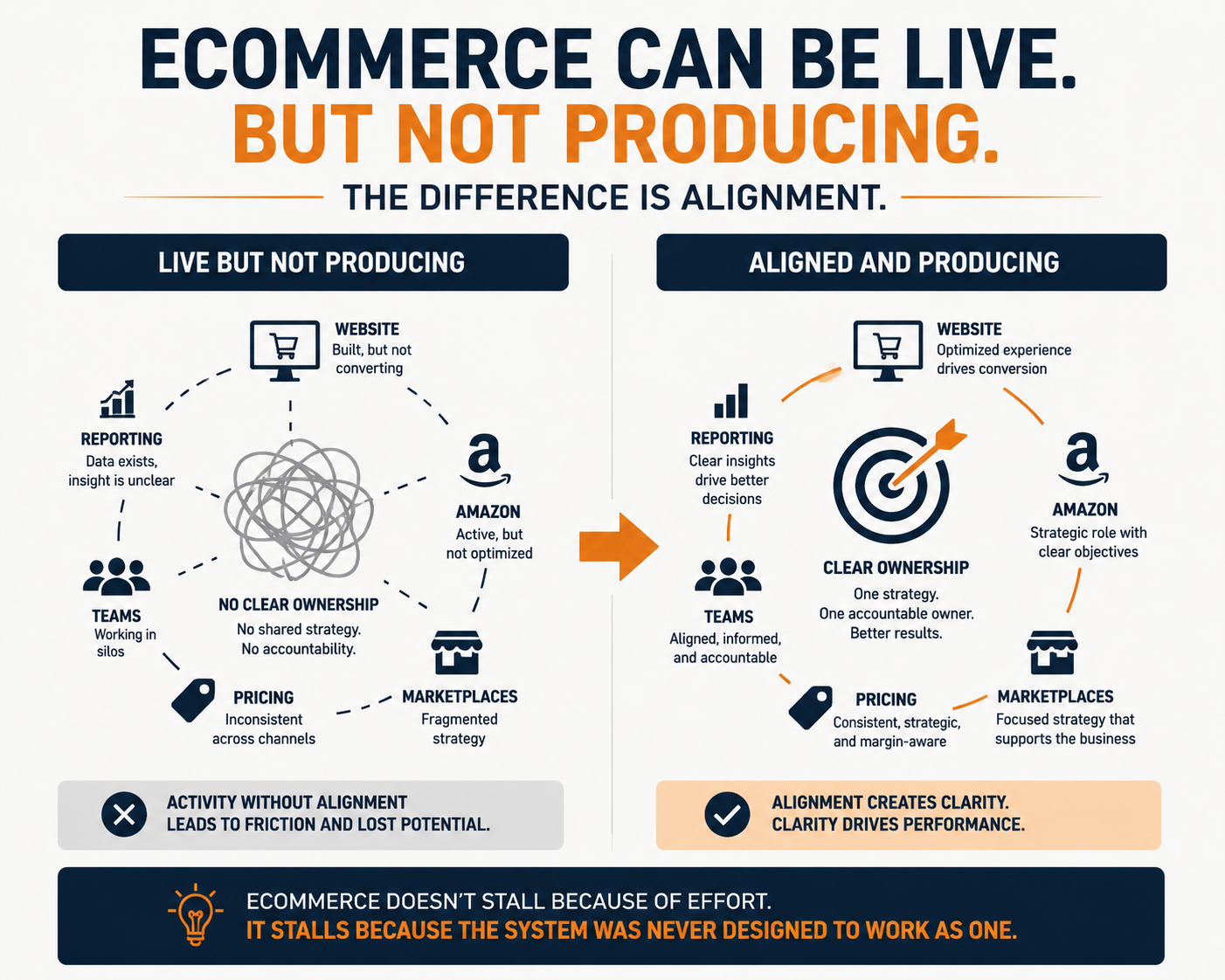
Why Ecommerce Performance Stalls
When results fall short, the instinct is often to look for a lever to pull.
More traffic. More ad spend. A new platform. Better integrations. More campaigns. More content. A different agency.
Those actions can help at the margins, and sometimes they are needed. But they rarely solve the deeper issue by themselves.
In many companies, ecommerce is not underperforming because there is a lack of tools or activity. It is underperforming because it was never structured to operate as a coordinated system.
Each channel was added with its own assumptions, processes, and expectations. Over time, those differences create friction. That friction shows up as inconsistent pricing, channel conflict, weak conversion, unclear ownership, disconnected reporting, and declining returns on effort.
At a certain point, the problem is no longer about optimization.
It is about alignment.
The business can keep trying to improve individual parts of ecommerce, but if the channels are working from different assumptions, the gains will usually be limited. Better traffic will not fix unclear channel roles. A cleaner website will not fix pricing conflict. A new marketplace will not fix weak ownership. More reporting will not fix a lack of accountability.
The system has to make sense before the tactics can fully work.
What This Looks Like in the Business
This pattern is fairly consistent across companies.
Ecommerce exists, but there is no shared understanding of how it is supposed to operate. There is no clear ownership of performance. There is no consistent framework for how channels should support one another.
You can see it in the questions that do not have clear answers:
How should pricing be managed across channels?
What role should Amazon play relative to direct ecommerce?
How should marketplace promotions be coordinated?
What should the website do that Amazon cannot?
Which customers should be served direct, and which should still go through existing sales channels?
Who is accountable for ecommerce margin, not just revenue?
Who owns the outcome when performance falls short?
These questions are not minor details. They shape whether ecommerce becomes a productive part of the business or another source of internal friction.
When the answers are unclear, responsibility gets distributed by default. Sales, marketing, operations, finance, and customer service all contribute, but no one may be fully accountable for the full ecommerce outcome.
That makes it harder to diagnose problems. It makes it harder to prioritize improvements. It makes it harder to scale what is working. And it makes it much easier for the same issues to keep coming back in different forms.
What Actually Changes Performance
Ecommerce begins to produce when it is treated as a system rather than a collection of independent channels.
That shift starts with alignment.
Ownership needs to be aligned, so there is a clear point of accountability. Channels need to be aligned, so each one has a defined role within the broader strategy. Pricing and promotions need to be aligned, so the customer experience is more consistent and the business understands the margin impact. Teams need to be aligned, so decisions are coordinated rather than reactive.
Without that structure, more effort tends to amplify the inefficiencies that already exist.
A campaign may drive more traffic, but expose weak conversion. A promotion may increase orders, but compress margin. A new marketplace may create revenue, but also create more operational complexity. A website improvement may help one part of the buying experience while pricing or fulfillment issues still hold performance back.
The point is not that ecommerce needs to become overly complicated. The point is that the business has to define how the pieces are supposed to work together.
That is what separates ecommerce that is merely live from ecommerce that produces.
The Pattern to Recognize
When ecommerce has been added but not aligned, the symptoms are predictable.
Amazon exists, but it is not competitive.
The website is live, but conversion is inconsistent.
Marketplace channels generate activity, but do not scale in a meaningful way.
Pricing works in one channel, but creates tension in another.
Promotions create short-term lifts, but not lasting improvement.
Teams are involved, but ownership remains unclear.
Individually, these issues can appear manageable. Collectively, they point to a deeper problem: the system was never designed to function as one.
That does not mean the business has to start over. In most cases, the company does not need to rebuild ecommerce from the ground up. It needs to bring structure to what already exists.
That is where performance begins to change.
Closing
Most companies in this position do not need another disconnected ecommerce project.
They need a clearer way to connect the work already happening.
The website, Amazon, marketplaces, pricing, promotions, customer experience, operations, and reporting all need to support a shared commercial outcome. Without that, ecommerce stays active but inconsistent. With it, the business can start turning existing channels into a more reliable source of growth.
Ecommerce being live is only the starting point.
The real question is whether it is structured to produce.
If This Sounds Familiar
Many of the teams I work with already have ecommerce in place. The challenge is not starting from zero. It is getting existing channels to operate in a way that consistently produces revenue, margin, and customer behavior the business can build on.
That is where an Ecommerce Assessment can help clarify what is working, what is disconnected, and what needs to change first across ownership, channel strategy, pricing, customer experience, and performance.
If you are working through something similar, I’m always open to comparing notes.